
Peter LaNasa, MD
Radiation Oncologist
Known for his patient-first approach and expertise in advanced radiation therapy.
New Welcome to our newly launched website. Same two centers, same physicians, and everything easier to find.

2D and 3D Conformal Radiation Therapy
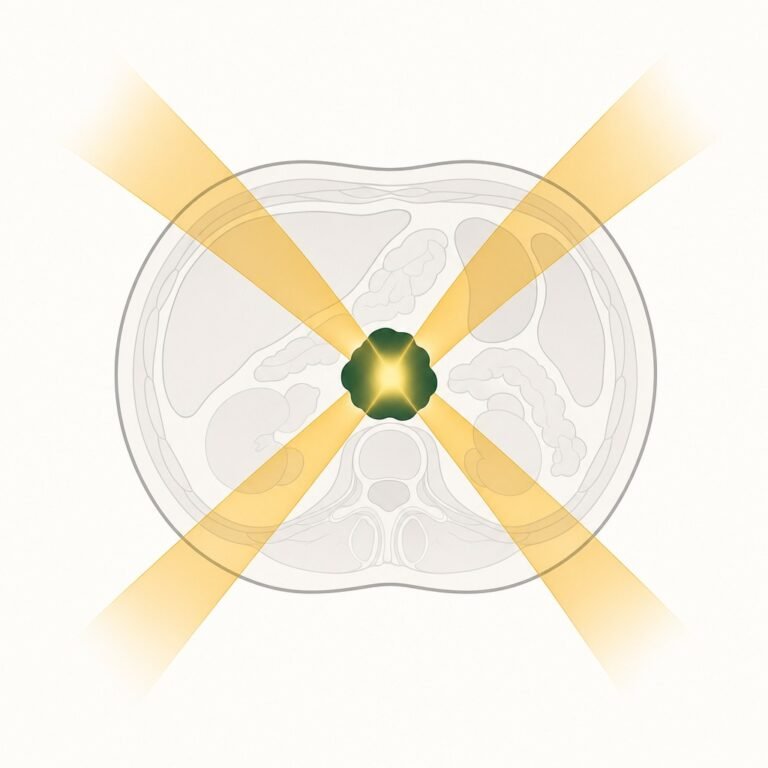
Beams shaped to match the outline of the target, planned from a scan of you. It is simpler than IMRT, it is quicker to plan and deliver, and for a great many treatments it does the job just as well. Newer is not automatically better.
Most insurance accepted and Medicare is welcome. See how referrals, insurance and cost work.
Why it is still used
The beam is blocked into the outline of what is being treated, planned on a CT scan of you rather than from a standard diagram.
A simpler plan takes less time to build and check. When treatment is being given to relieve pain, getting started matters more than elegance.
An electron beam gives its dose near the surface and stops, which suits skin and other superficial targets and spares what lies beneath.
A simpler plan is a plan with less to go wrong in delivery. That is a real clinical argument, not a consolation.
In plain words
Your target is outlined on a planning CT, and the machine shapes each beam to that outline, usually with a bank of movable metal leaves inside the head of the machine. Several beams come in from different angles and overlap on the target, so the target gets the full dose while each individual path through you gets much less.
The difference between the two is what the plan is drawn on. 2D treatment is planned from plain X-rays, using the bones as landmarks, and the field is a simple square or rectangle. 3D treatment is planned on a CT scan, so the beam is shaped to the outline of the target itself and far less healthy tissue sits in the full dose.
3D is what we use for most courses. 2D still has its place, and it is chosen for speed rather than as a compromise: when a bone deposit is causing pain, or a whole area such as the brain or the pelvis needs treating, starting today matters more than shaving a millimetre off the field.
The difference from IMRT is that the strength across each beam stays even instead of being varied across the field. That matters when a target wraps around something delicate. It matters much less when the target is a reasonably simple shape and nothing critical is pressed against it, which is a great deal of the time.
Both centers also offer electron-beam treatment. Electrons deposit their dose within the first centimetres and then stop, which is exactly what you want for something at or near the skin and exactly what you do not want for something deep.
How it works
Your radiation oncologist decides whether radiation helps in your case, and which technique fits. What to bring, whether you need a referral, and how insurance is handled is set out on our new patients page.
A planning scan in the exact position you will be treated in. Small marks on the skin, and sometimes a mold or headrest, make sure you lie the same way every day. Those marks may be permanent, and we will tell you which before the scan rather than after it.
Your target is outlined and the beams shaped to it. A conformal plan is usually quicker to produce than an IMRT plan, which is part of why it is chosen when treatment needs to start promptly.
Short daily appointments. How many depends entirely on what is being treated and why, and you will be given your exact number at your planning appointment rather than left guessing.
You are seen weekly during the course and again afterwards, so side effects are managed as they appear rather than after they have built up.

The best treatment is the one that fits.
Choosing a simpler technique where a simpler technique is right is not settling. It is the same judgement that stops us using a complicated one where it would add nothing.
Who it is for
Which technique you are offered is a clinical judgement about your anatomy and your target, not a tier of service. If you would like to know why one was chosen over another in your case, ask, and you will be given a straight answer.
Our doctors
Radiation Oncologist
Known for his patient-first approach and expertise in advanced radiation therapy.

Radiation Oncologist
Focused on precision treatment planning and compassionate, whole-person care.
Questions
No. It is a simpler technique, and simpler is not the same as older or worse. It runs on the same linear accelerator as everything else we do, planned on the same scanner, with the same checks. Where a more complex plan would genuinely protect something, you get the more complex plan. Where it would only add time and complication without protecting anything, you get this, and that is the better care.
With conformal treatment the beam is shaped to the target but its strength stays even across the field. With IMRT the strength is varied across the field as well, which lets the dose bend around something delicate. The second is worth having when a target wraps around a critical structure. When it does not, the extra complexity buys you nothing.
Electrons give up their dose in the first few centimetres and then stop, rather than carrying on through you. That makes them well suited to something at or near the skin, because the tissue underneath is largely spared. For anything deep they are the wrong tool, and photons are used instead.
Not inherently. Side effects follow the dose and the area treated rather than the label on the technique. Where a target sits against something delicate, a more shaped plan can reduce what that structure receives, and that is exactly when it is used. Your oncologist will go through the effects that apply to your treatment, and how likely each is, before you consent to it.
Where it is appropriate, yes. Image guidance is used according to what is being treated and what is nearby, not according to which planning technique was chosen.
Yes. Both 2D and 3D conformal treatment, with photon and electron beams, are available in Arlington and Fort Worth.
Patient stories
Dr. Lanasa put me at ease immediately and was zeroed on me at each weekly visit during my eight weeks of therapy. His bedside manner is that of a caring and concerned doctor. Staff, like Dr. Lanasa is second to none.
Above Excellent. This man spent literally 2 hours, explaining to me my treatment plan. He is an extremely optimistic inspiring and informative physician. Extremely compassionate. We need more Doctors like him. Thank you so much.
I am so happy I picked Dr. Barker as my husband's doctor. When we learned my husband oral cancer we were shocked and lost about how to start treatment. Dr. Barker was the first doctor we saw and he led us to my husband's surgeon and oncologist. Dr. Barker explained everything to us and answered all our questions. He is the most wonderful doctor. When a family has to go through cancer it make so much easier when you have a doctor like Dr. Barker. He really cares about his patients and their family.
Prostate Treatment by Radiation Therapy completed at the USMD Prostate Cancer Center in Arlington. Dr. Lanasa is exceptional and his staff is very professional. Technicians are friendly and call patients by name and also get you in and out quickly as they know their business.
The best Professional staff and technition help I have ever been involved with in my 66 years. They save my life.
I picked this guy off the internet for no other reason than he had attended college in my home town and of course was a radiation oncologist which is what I needed. The thing I liked best was his honest and direct answers to all my many questions.He was optimistic and the outcome of the radiation was just as he said it would be. What a lucky choice for me.
01 / 06
Online requests are secure and confidential.
This page is for information and is not medical advice. Which technique suits you depends on your diagnosis, the site being treated and your general health. Please talk to a qualified physician about your own condition.